
Acute Vestibular Syndrome: When Should You Perform the HINTS+ Examination?
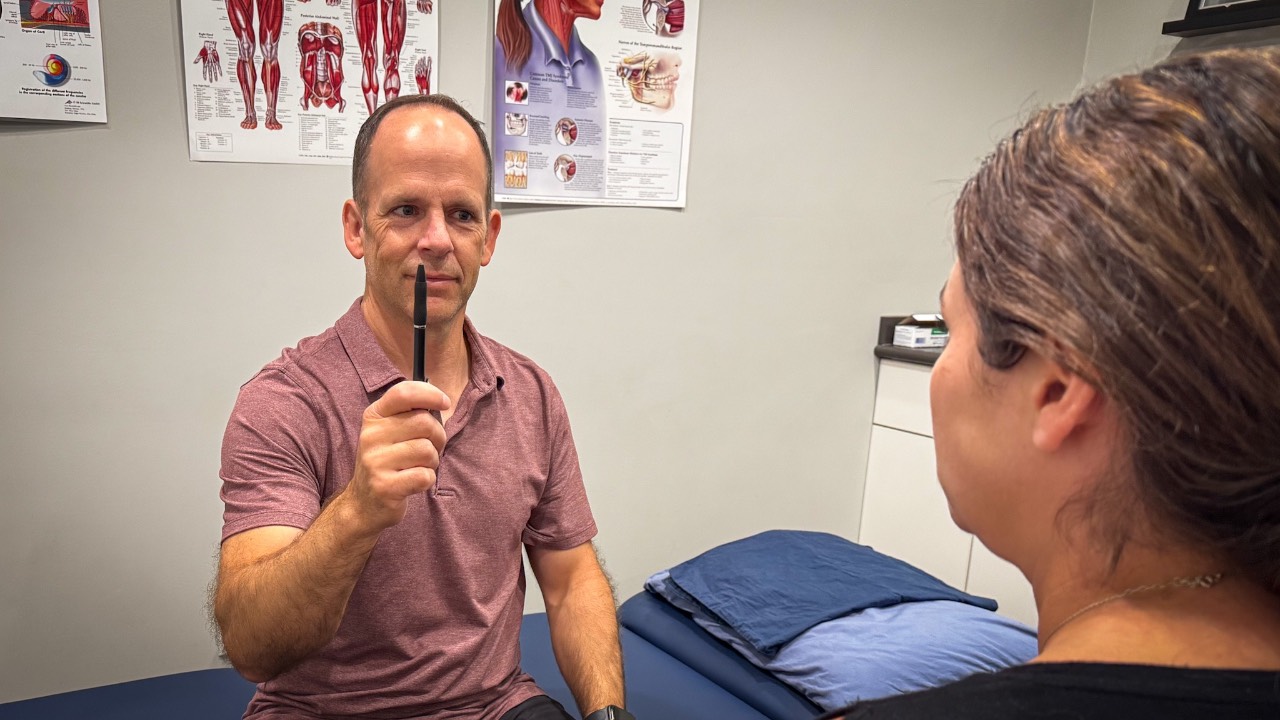
You have a patient sitting in front of you with acute dizziness.
Should you perform the HINTS+ examination?
The answer depends on one critical question:
Does your patient have Acute Vestibular Syndrome (AVS)?
One of the most common mistakes we see is clinicians performing HINTS+ on patients who do not meet the criteria for Acute Vestibular Syndrome. The examination was developed and validated in a very specific patient population. When applied outside of that population, the evidence demonstrating HINTS+ to be more sensitive than early MRI no longer applies.
Before discussing HINTS+, let's first answer the more important question.
What Is Acute Vestibular Syndrome?
Acute Vestibular Syndrome (AVS) is a clinical syndrome, not a diagnosis.
Patients with Acute Vestibular Syndrome present with the sudden onset of continuous dizziness or vertigo caused by an acute condition affecting either the peripheral or central vestibular system. The syndrome has many potential causes, including vestibular neuritis, posterior circulation stroke, multiple sclerosis, and other neurological disorders.
The purpose of the HINTS+ examination is not to determine whether a patient has Acute Vestibular Syndrome. Instead, once you've determined that your patient has AVS, HINTS+ helps distinguish whether the cause is more likely peripheral or central.
Throughout this article, Acute Vestibular Syndrome refers to the patient population in which the original HINTS study was validated.
Acute Vestibular Syndrome Criteria
Patients with Acute Vestibular Syndrome typically present with:
- Acute onset of dizziness or vertigo
- Continuous symptoms
- Continuous spontaneous lateral nystagmus
- Head-motion intolerance
- Nausea and/or vomiting
- Gait instability
- Symptoms that are continuous and typically persist for at least 24 hours
Note: You don’t need to wait 24 hours to identify Acute Vestibular Syndrome (AVS). If a patient develops acute, continuous vertigo or dizziness and remains persistently symptomatic at the time of assessment, they may already have AVS. The ≥24-hour duration describes the expected course of the syndrome, not a requirement to delay assessment or diagnosis for 24 hours.
Clinical Pearl
Before reaching for HINTS+, stop and ask yourself one question:
Does this patient truly have Acute Vestibular Syndrome?
Why Do We Now Say HINTS+?
The original 2009 study by Kattah and colleagues evaluated the HINTS examination, consisting of three tests:
- Head Impulse Test
- Assessment of Nystagmus
- Test of Skew
Today, HINTS+ generally refers to the original HINTS examination plus a bedside hearing assessment. A simple bedside hearing screen, such as a finger rustle test, should be performed in all patients with acute vestibular syndrome. New unilateral hearing loss raises suspicion for the less common but important AICA stroke, a central cause of an acute audiovestibular syndrome that can mimic labyrinthitis.
Mistake #1: Performing HINTS+ Without Acute Vestibular Syndrome
Perhaps the most common error is applying HINTS+ to patients who do not have Acute Vestibular Syndrome (AVS).
Many patients present with dizziness due to conditions such as benign paroxysmal positional vertigo (BPPV), vestibular migraine, Ménière's disease, orthostatic hypotension, or transient ischemic attacks. While vestibular migraine and Ménière's disease can occasionally cause prolonged symptoms, they often present with episodic attacks or lack the clinical features required to meet the definition of AVS.
The HINTS+ examination has only been validated in patients with Acute Vestibular Syndrome, that is, acute-onset, continuous dizziness accompanied by spontaneous nystagmus, head-motion intolerance, gait unsteadiness, and nausea or vomiting. If your patient does not meet these criteria, you can no longer assume that the evidence demonstrating HINTS+ to be more sensitive than early MRI applies.
Mistake #2: Missing a Defining Feature of Acute Vestibular Syndrome
Acute Vestibular Syndrome is characterized by continuous spontaneous lateral nystagmus.
Without spontaneous nystagmus, interpreting the nystagmus component of HINTS becomes difficult or impossible, and the patient may no longer resemble those included in the original validation studies.
This doesn't necessarily mean the patient cannot have a stroke. It simply means the evidence supporting HINTS+ may no longer apply.
Mistake #3: Assuming MRI Rules Out Stroke
One of the reasons HINTS became so influential is that early MRI is not perfect.
Diffusion-weighted MRI can miss posterior circulation strokes during the first 24–48 hours after symptom onset.
Why?
MRI identifies structural injury. HINTS+ evaluates vestibular and ocular motor physiology. Abnormal physiological function may develop before structural injury becomes visible on MRI, allowing an expertly performed bedside examination to identify some strokes earlier than imaging.
This does not mean HINTS+ replaces MRI.
Rather, HINTS+ helps determine which patients require urgent neurological assessment and repeat imaging despite an initially negative MRI.
Why HINTS+ Is So Powerful
In the original Kattah study, the presence of any one of the following findings strongly suggested a central cause:
- Normal head impulse test
- Direction-changing gaze-evoked nystagmus
- Skew deviation
Among patients with Acute Vestibular Syndrome, HINTS demonstrated 100% sensitivity and 96% specificity for stroke, outperforming early diffusion-weighted MRI in that carefully selected patient population.
Those results are remarkable, but only when the examination is performed in the right patient.
Acute Vestibular Syndrome and HINTS+: The Key Take-Home Message
Before performing HINTS+, ask yourself one question:
Does this patient truly have Acute Vestibular Syndrome?
If the answer is no, you can no longer assume that the evidence demonstrating HINTS+ to be more sensitive than early MRI applies.
The HINTS+ examination should never be used to determine whether a patient has Acute Vestibular Syndrome.
It should only be used after you have already determined that they do.
The greatest strength of HINTS+ is not simply knowing how to perform it.
It's knowing when the evidence applies.
Want to Learn HINTS+ With Confidence?
Correctly identifying Acute Vestibular Syndrome is only the first step.
Our free HINTS+ course reviews:
- When HINTS+ should (and should not) be used
- How to perform each component correctly
- Common clinical pitfalls
- When patients require urgent referral
Access the free course here:
👉🏻 https://courses.north49therapy.com/hints
References
- Kattah JC, Talkad AV, Wang DZ, Hsieh YH, Newman-Toker DE. HINTS to Diagnose Stroke in the Acute Vestibular Syndrome. Stroke. 2009.
- Newman-Toker DE. Acute Vestibular Syndrome (AVS) Course Syllabus.
- Newman-Toker DE, et al. Normal Head Impulse Test Differentiates Acute Cerebellar Strokes from Vestibular Neuritis. Academic Emergency Medicine. 2013.
- Newman-Toker DE, Edlow JA. TiTrATE: A Novel Approach to Diagnosing Acute Dizziness and Vertigo.Neurologic Clinics. 2015.
Author

Kregg Ochitwa
Physical Therapist I Vestibular Therapist I Clinic Owner
Categories
All Categories